blog
Tencent's Hy3: a 295B model that runs at the cost of a 21B one
Hy3 has 295 billion parameters, but each token passes through only 21 billion of them. The MoE architecture, its benchmark scores next to GLM-5.2, the price once the free tier is gone, and which jobs to give it.
- Published
- Updated on
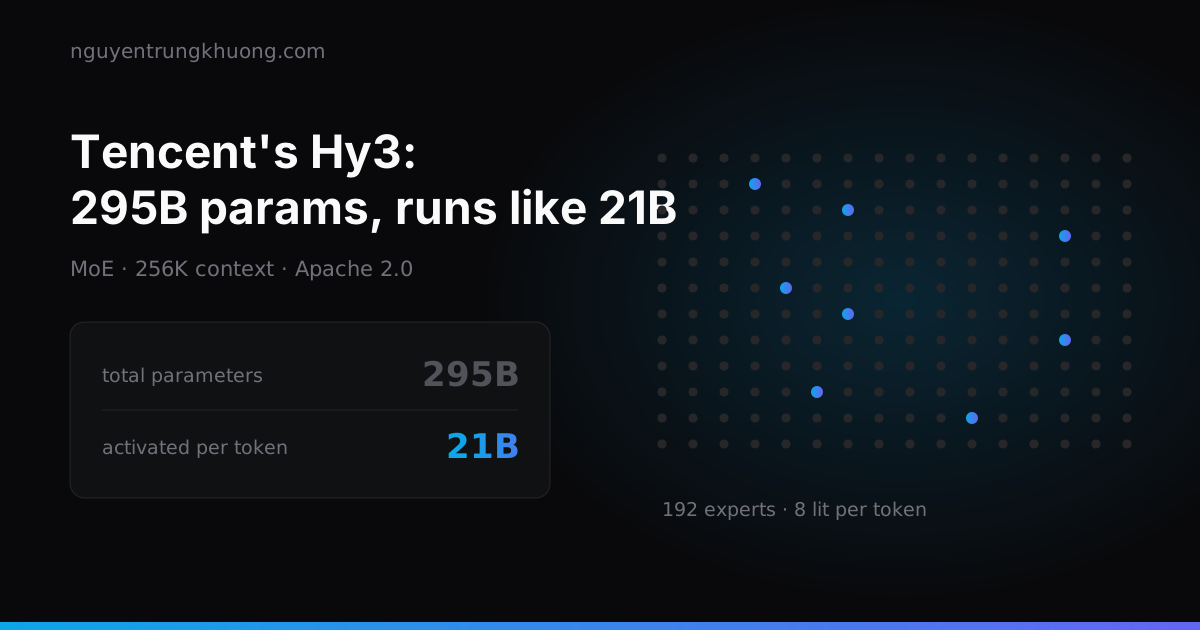
Tencent released Hy3 on 6 Jul 2026 under the Apache 2.0 license, after a preview in late April. The number that gets attention is 295 billion parameters. The number that matters more is that each token passes through only 21 billion of them.
Whether Hy3 is worth using comes down to the cost per token and the 5.4% hallucination rate, more than to the benchmark table.
295B parameters, but only 21B run each time
Hy3 is a Mixture-of-Experts model. It has 192 experts, and for each token the router sends it through the 8 best-suited experts instead of the whole network. The rest stays idle.
Some concrete specs: 80 layers plus one 3.8-billion-parameter MTP layer, 64 attention heads using GQA with 8 KV heads, a hidden size of 4096, a vocabulary of 120,832 tokens, and a 256K context window.
Hy3 benchmarks next to GLM-5.2
On reasoning, Hy3 scores 90.4 on GPQA Diamond, 72.0 on USAMO 2026 and 90.0 on IMOAnswerBench. On coding: 78.0 on SWE-Bench Verified, 75.8 on SWE-Bench Multilingual, 71.7 on Terminal-Bench 2.1.
Put it next to GLM-5.2, though, and the picture changes completely:
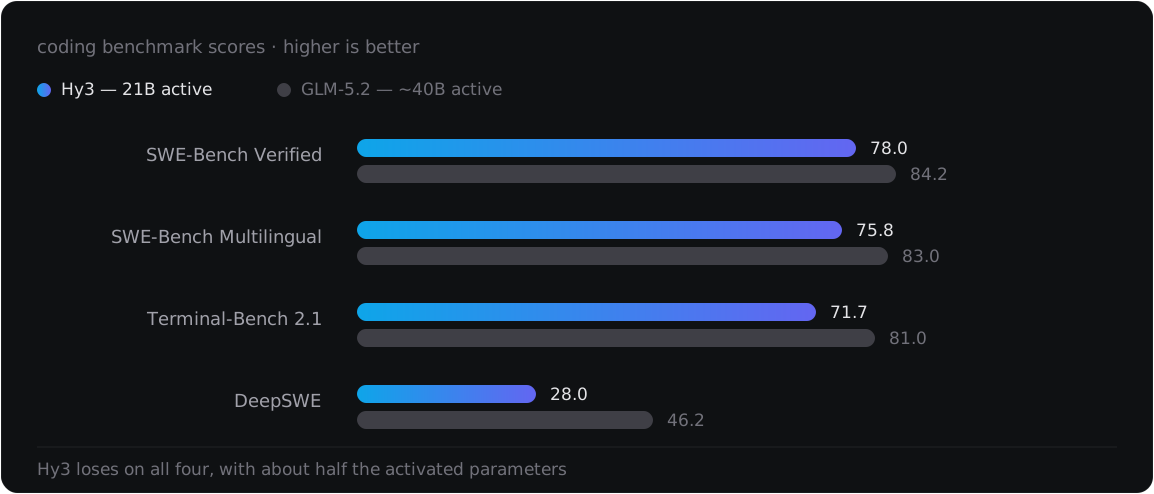
Hy3 loses on all four, and on DeepSWE it loses by a wide margin. In exchange, GLM-5.2 has 753 billion total parameters according to its model card and about 40 billion activated parameters, close to twice Hy3 on the part that actually costs money.
The fair reading: Hy3 gives good performance for the money, without being the strongest model. In a blind evaluation with 270 experts and 312 valid comparisons, Hy3 scored 2.67/4 against 2.51/4 for GLM-5.1: ahead, but not by much.
One caveat about every number in this section: Tencent published them. In the original table, cells marked with an asterisk are scores Tencent re-ran itself for competitors' models instead of using the numbers those vendors published, and all four GLM-5.2 cells in the coding group carry that asterisk. The blind evaluation was also organized by Tencent's own research team, which recruited the judges. At the time of writing, no independent party has published its own measurements of the release version.
How the release differs from the preview: common-sense errors, multi-turn errors, hallucination rate
Most of the work between the two versions went into stability rather than benchmark scores, and stability is what affects real use:
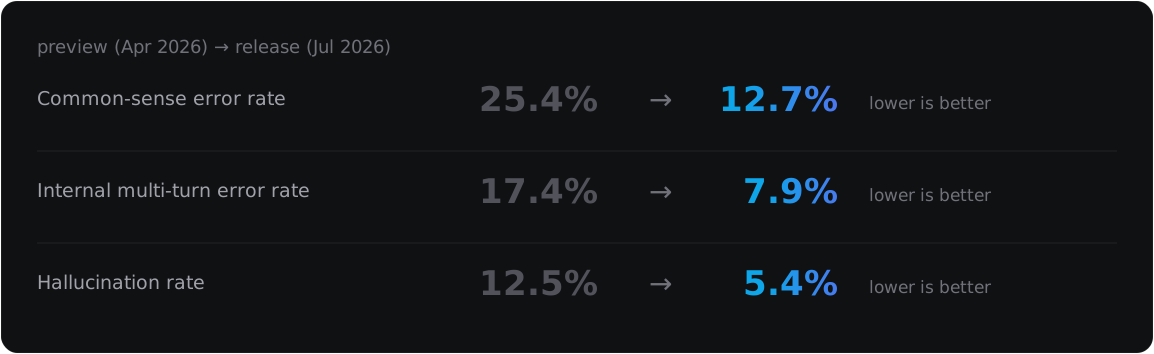
The hallucination rate dropping from 12.5% to 5.4% is the number I watch most. 5.4% means that roughly one answer in twenty is wrong while sounding very convincing.
Jobs I would give Hy3
The general rule: give it work where I can check the result in a few seconds.
- Translating and summarizing long technical documents, where a mistake shows up as soon as you read the original
- Writing first drafts of product descriptions, emails, service page copy
- Explaining an unfamiliar piece of code, or a library I have never used
- Generating sample data, writing small scripts, converting formats
- Reviewing a piece of code for obvious bugs before I read it closely myself
The 256K-token window suits reading a whole long log file, or a third party's entire API documentation, in one pass. KiotViet is a Vietnamese point-of-sale system for retail shops; when I built a sync integration with its API, the most time-consuming part was reading the documentation to get the meaning of each field right. That is exactly the kind of work to hand to a cheap, fast model.
Jobs I would not give Hy3
System architecture, technology decisions, and anything that goes straight to production without a person reading it again.
The problem is not that Hy3 is bad. A 5.4% hallucination rate is low enough to make you drop your guard and high enough that one time in twenty it gets you. For decisions where a mistake only shows up weeks later, that rate is not acceptable.
The DeepSWE score of 28.0 also says something specific: long, multi-step coding tasks where the model has to fix its own mistakes are not where Hy3 is strong.
How long does Hy3 stay free?
Many social media posts promise huge quotas, so this section needs exact numbers.
At launch, Hy3 was on OpenRouter both as a paid version and as a :free version. The free version really did cost nothing per token, but the limit is on requests, not tokens: 20 requests/minute, 50 requests/day for an account that has never bought credits, and 1,000 requests/day once you have bought at least 10 USD. That quota is shared by every :free model and counted per account, not just for Hy3. There is no "200 million tokens per day" here. That figure comes from multiplying the request quota by the maximum context length, a calculation that does not reflect real use.
The list price of the paid version, read on 28 Oct 2026: 0.132 USD per million input tokens and 0.528 USD per million output tokens (on 23 Jul 2026 it was 0.1288 and 0.5336). On the same day, 28 Oct 2026, the :free version was no longer in OpenRouter's model list.
Calling Hy3 in five minutes
OpenRouter's endpoint is OpenAI-compatible, so most SDKs only need a different baseURL:
const res = await fetch('https://openrouter.ai/api/v1/chat/completions', {
  method: 'POST',
  headers: {
    Authorization: `Bearer ${process.env.OPENROUTER_API_KEY}`,
    'Content-Type': 'application/json',
  },
  body: JSON.stringify({
    model: 'tencent/hy3',
    reasoning_effort: 'low', // no_think | low | high
    messages: [{ role: 'user', content: 'Summarize the following document in 5 bullet points: ...' }],
  }),
})
The reasoning_effort parameter is the one most worth playing with. Set no_think for translation, summaries and format conversion: much faster, with no loss in quality. Only turn on high when the question really needs multi-step reasoning.
What self-hosting Hy3 takes
The weights are fully open under Apache 2.0 and download from Hugging Face. The reference setup is 8 H20-3e GPUs, or cards with more memory, running at BF16 precision; an FP8 version is available if you are short on VRAM.
vllm serve tencent/Hy3 \
  --tensor-parallel-size 8 \
  --speculative-config.method mtp \
  --speculative-config.num_speculative_tokens 2 \
  --tool-call-parser hy_v3 \
  --reasoning-parser hy_v3 \
  --enable-auto-tool-choice
The MTP layer is what speculative decoding uses: it predicts several tokens ahead at each step, which buys a higher generation speed. SGLang supports the same.
For a small web design studio, self-hosting makes no economic sense. Eight of those GPUs cost more than many years of API fees. The value of the Apache 2.0 license here is that you can leave if the provider changes its prices or shuts down, not that you should set it up yourself right away.
When Hy3 is worth using
Hy3 is not the strongest model available, and Tencent does not market it that way. It is the best open model in the low-cost group right now: broad knowledge, long context, solid English, usable Vietnamese, a clean license.
A sensible way to use it is to let Hy3 carry the high-volume, light work (translation, summaries, drafts, explanations, small scripts) and save the expensive models for the parts that are really hard.
Related posts
all posts → REA: letting an agent reverse engineer software, then testing the oracle tooREA lets a coding agent read a program that has no source, down to machine code, then rebuild that feature in its own code. Whether the rebuild is right is up to the oracle, and the oracle is code too, with its own bugs.read more →
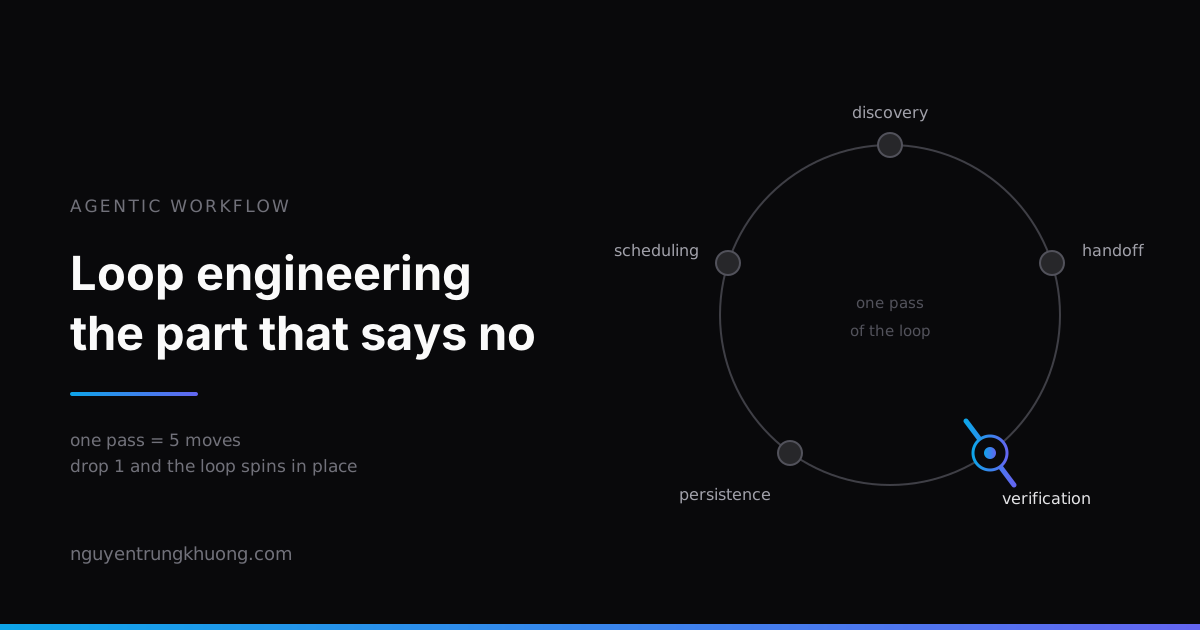 Loop engineering: stop prompting the agent, design the loop that prompts itBuilding a loop for an agent now takes fifteen minutes. The hard part is putting something inside it that dares to say "no". The five moves of one pass, five ways a loop fails, and the real loop on this site, which is halfway there.read more →
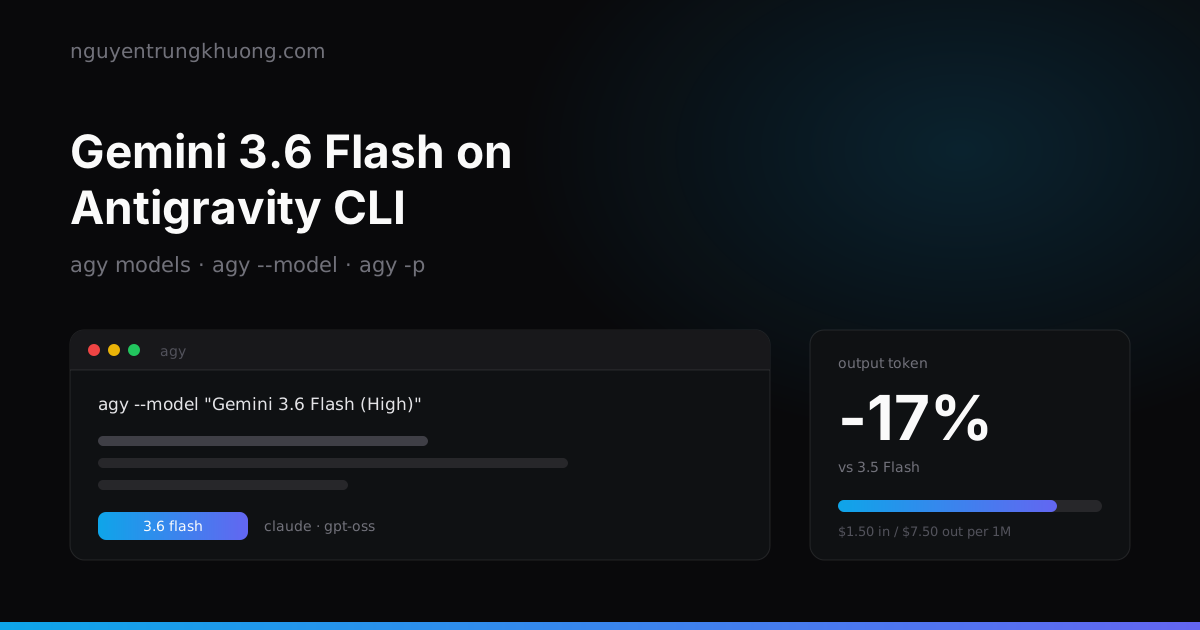 Gemini 3.6 Flash on Antigravity CLI: 17% fewer output tokensGoogle replaced Gemini CLI with Antigravity CLI, and 3.6 Flash is the model worth making the default in the terminal. How to pick a model with agy, run it headless, and work out the cost of one agent run.read more →
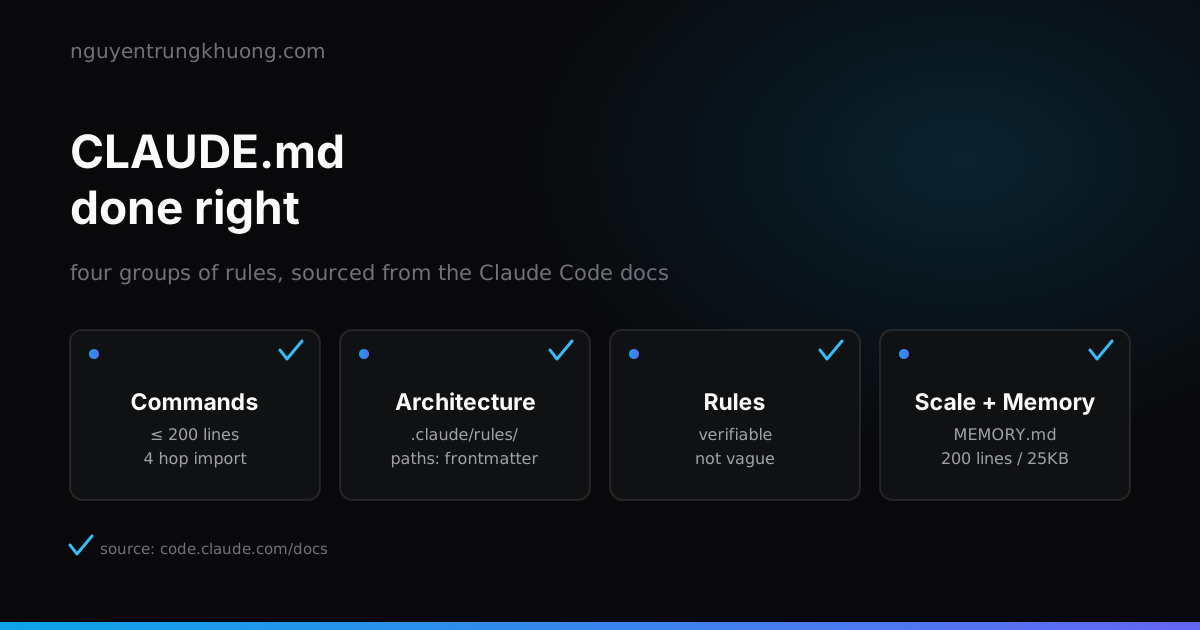 Writing a good CLAUDE.md: four rule groups and the real limits of Claude CodeCLAUDE.md works well when it is split into four clear groups: commands, rules, path-scoped architecture, and how to scale as the project grows. How to write each group within the real technical limits of Claude Code, with examples that run.read more →